Five warning signs your oil pickup tube is failing silently
Oil starvation rarely announces itself with a dashboard light. Most pickup tube failures develop inside the sump where routine service never looks — until bearing damage has already started.
Why pickup tube problems stay hidden
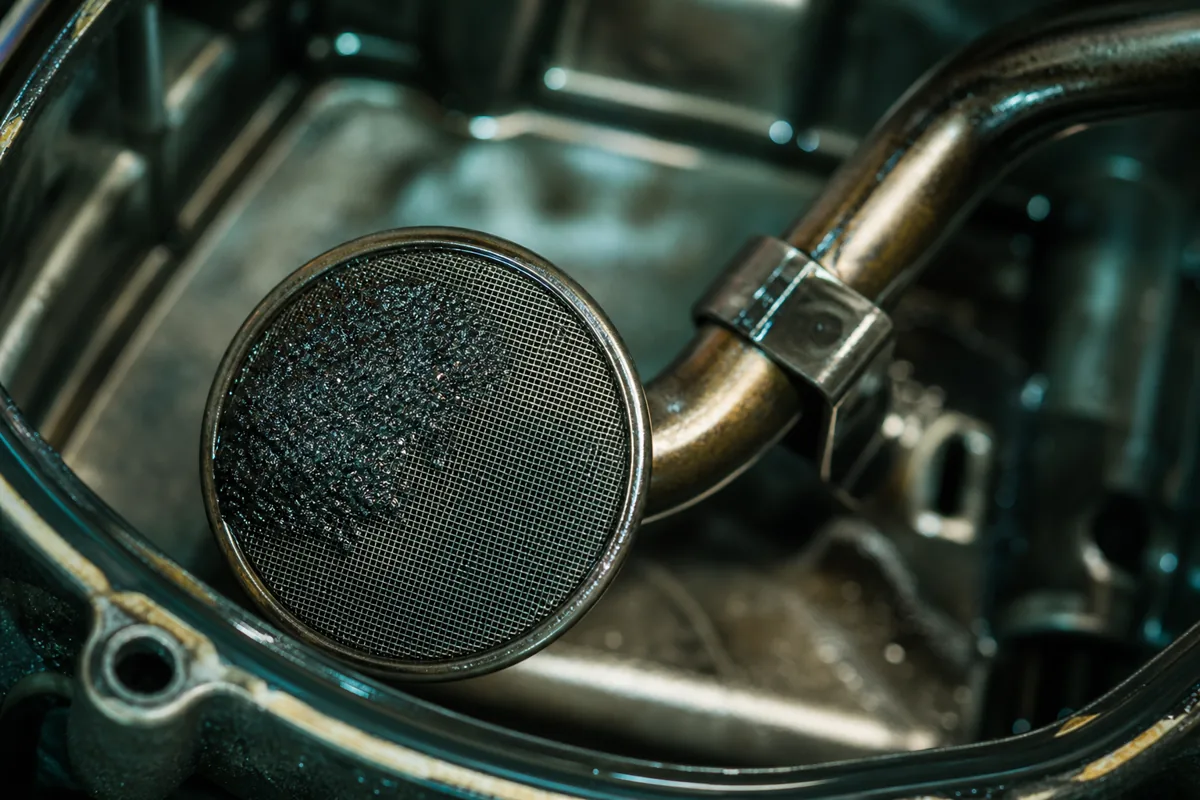
The oil pickup tube sits at the lowest point of the oil pan, drawing lubricant through a mesh screen before it reaches the pump. From above the engine bay, nothing looks wrong. Oil level on the dipstick reads normal. There is no external leak. Yet partial restriction at the screen or a hairline crack along the tube can reduce flow enough to starve bearings during cold starts or high-RPM operation.
At vermiculate, we inspect this zone with borescope access through the drain plug opening or by removing the pan when distortion is suspected. Photo documentation shows exactly what a dipstick check cannot — debris packed against the screen, tube wall thinning, or a pickup tube pulled away from its mounting flange after pan impact.
Sign 1: Ticking or knock that fades as the engine warms
A brief lifter tick or light knock during the first thirty seconds of operation often points to delayed oil pressure build-up. When the pickup screen is partially clogged, the pump pulls air or pulls through a restricted path until oil thins and flows more easily. Owners describe it as something that goes away once the car is warm — which makes it easy to dismiss.
If the sound returns after the engine cools down again, treat it as a pressure delivery issue rather than a harmless quirk. Measuring actual oil pressure at the sender port while cold confirms whether the pump is working against restriction downstream.
Sign 2: Oil pressure gauge reads lower than factory spec at idle
On vehicles with a functional pressure gauge or digital readout, compare hot idle pressure against manufacturer specifications. A pickup restriction typically shows up as a few PSI below normal at idle while highway pressure looks acceptable. That split pattern is different from worn main bearings, which tend to drop pressure across all RPM ranges.
Always verify sender accuracy before condemning the pickup assembly. A failing sender can mimic restriction symptoms. Cross-check with a mechanical gauge temporarily installed at the block port.
Sign 3: Metallic debris in the drain oil but no external leak
During an oil change, shine a light into the drain stream or inspect the filter pleats after cutting the filter open. Fine brass or copper-colored particles combined with normal oil level suggest wear downstream of a starvation event — often rod or main bearing material. The root cause may still be at the pickup: restricted flow caused the bearing damage, not the other way around.
Sludge accumulation on the pickup screen is common on engines with extended oil change intervals or short-trip driving patterns. The screen acts as a filter of last resort, and once it cakes over, flow drops before the full-flow filter ever sees the problem.
Sign 4: Recent underbody impact or pan contact
Hitting a parking block, curb, or road debris can deform the oil pan and shift the pickup tube mounting position. Even without a visible dent from above, the tube may pull slightly off its seat, creating an air gap at the inlet. We document pan flatness and pickup alignment during hidden-zone inspections because this failure mode leaves no code and no leak — only intermittent starvation.
Sign 5: High-RPM noise under hard acceleration
When demand for oil volume peaks during hard throttle, a restricted pickup cannot keep up. The result may be a brief rattle or valvetrain noise that appears only under load. Some owners notice it merging onto a highway on-ramp or passing at speed — conditions where oil demand spikes and any flow limitation becomes obvious.
Pair this symptom with oil analysis if available. Elevated silicon or wear metals in a sample taken before the next change can support the case for internal inspection even when external checks look clean.
What a proper pickup tube inspection includes
- Visual and borescope assessment of the pickup screen and tube condition through approved access points
- Measurement of oil pressure cold and hot at the block port with a verified gauge
- Pan inspection for deformation, previous sealant abuse, or stripped mounting threads
- Photo documentation of screen condition, tube routing, and O-ring or gasket seating at the pump inlet
- Recommendation for cleaning, tube replacement, or pan straightening based on documented findings — not guesswork
Replacing a pickup tube without confirming the screen condition or pan geometry often repeats the same failure within a few thousand miles. Access and evidence come first; parts follow the photos.